
What is demineralised water (fully desalinated water)?

Jan 31, 2024, 14:51:35

VE water, also called demineralized water, demineralized water or deionized water, is treated water in which the conventional minerals (salts) have been removed. VE water is specifically required for technical applications, for example as a heat transfer medium in the cooling circuit. Sometimes demineralized water is also used as a cleaning agent.

In special cases even ultrapure water is required. Ultrapure water must meet certain purity requirements.

The quality and purity of demineralised water is determined by its electrical conductivity. The conductivity is usually given in µS/cm.
ve-water-ibc-container_2

Production of demineralized water

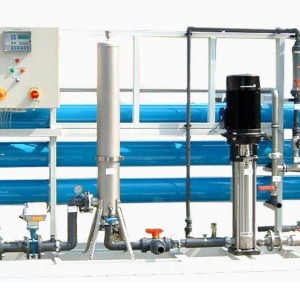
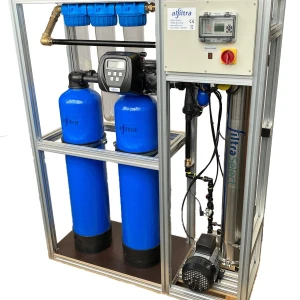
Alfiltra offers complete water treatment systems for the production of demineralized water. These usually consist of a softening system or Penta filter system for well water, a reverse osmosis system and then a mixed bed filter. This is the most practical way to implement full desalination.

We would be happy to advise you by phone or email about our products for producing demineralised water.

Do you have questions?

0725 1936760
Contact form
Request a quote
Dealer registration

Product: ZIP countertop reverse osmosis system / water filter system

81 upvotes 1 answers
Answer:
0
Yes, that is the big advantage of this system. It can be operated anywhere where there is electricity. The water to be treated is simply poured into the tank.

Product: ZIP countertop reverse osmosis system / water filter system

72 upvotes 1 answers
Answer:
0
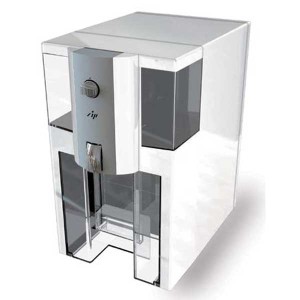
This system does not require any installation. Like a fully automatic coffee machine, it is simply placed on a table or in the kitchen, filled with water and connected to the power supply. The treated water ends up in a tank and can be easily removed.

Product: REOS Plug & Play reverse osmosis system with water softener

71 upvotes 1 answers
Answer:
0
Our industrial reverse osmosis systems achieve a conductivity of less than 10 µS. The system has a built-in display to monitor the conductivity. If a lower conductivity is to be achieved, we recommend using a mixed bed cartridge after the osmosis system. You can find this under the system accessories.

Product: REOS HOME Untertisch-Umkehrosmoseanlage

56 upvotes 1 answers
Answer:
0

Here you have to distinguish between two operating modes:

  • Standby mode : The tank is full and no water is being drawn off. In this case, the system does not make any noise.
  • Treatment mode : Water has been drawn off or the tank is being initially filled. In this case, the pump starts to increase efficiency. When the pump is running, the noise level of the system is less than 40 decibels (assuming it is in a closed cabinet), which is about the volume of a quiet conversation or quiet background noise in a library. This makes it ideal for use in kitchens, offices or practices where peace and quiet and a disturbance-free environment are important. The pump switches off immediately when the tank has been refilled (within a few minutes).

Product: REOS HOME Untertisch-Umkehrosmoseanlage

53 upvotes 1 answers
Answer:
0

The REOS HOME system is primarily designed for the filtration of tap water. Here are the details of the different types of water that can be filtered:

  • Tap water: The system is ideal for filtering municipal tap water. It effectively removes contaminants such as chlorine, heavy metals, uranium, calcium, sodium, nitrate, medical residues and microorganisms up to 99%.

  • Well water: The system can also filter well water, provided it meets the basic requirements for raw water for reverse osmosis systems. Well water can contain varying amounts of sediment and contaminants, so it is important to test the water quality before installation. A coarser pre-filter and in some cases an iron filter may be necessary before the system.

  • Rainwater: With appropriate pre-filtration, the system can also filter rainwater. However, it is recommended that the water is first pre-treated using sediment and carbon filters to remove larger particles and organic contaminants. Please note, however, that with rainwater, the filter replacement intervals can vary greatly (depending on the level of contamination).

  • Spring water: The system can also be used to filter spring water if the water is first tested for gross impurities and pretreated if necessary.

  • For all of the water types mentioned, it is important to ensure that the water quality meets the requirements of the reverse osmosis system to ensure optimal performance and service life of the filters. If there is any uncertainty about the water quality, a water analysis should be carried out and additional pre-filters installed if necessary.

    14 upvotes 1 answers
    Answer:
    0
  • Filtering Parasites: Countertop reverse osmosis systems are extremely effective at removing a variety of contaminants, including parasites. Reverse osmosis uses a semi-permeable membrane that is so fine that it can remove almost all dissolved solids from water, including microorganisms such as parasites. Parasites such as Cryptosporidium and Giardia that may be present in drinking water sources are effectively filtered out by this membrane, ensuring safe and healthy water quality.

  • Water treatment process: In a table-top reverse osmosis system, the water goes through several stages of treatment. The process typically includes the following steps:

    • Pre-filtration: Removes larger particles such as sand, rust and other sediments.
    • Activated carbon filter: Removes chlorine, bad smells and tastes as well as organic compounds.
    • Reverse osmosis membrane: This is the core of the system. The membrane removes up to 99% of all dissolved solids, including salts, bacteria and viruses, heavy metals and even parasites.
    • Remineralization: Perfect for improving taste and balancing pH.
  • In summary, a countertop reverse osmosis system provides a comprehensive solution for clean, safe and great-tasting water by effectively removing a wide range of contaminants, including parasites.

    13 upvotes 1 answers
    Answer:
    0
    The ratio of product water to waste water in the ZIP countertop reverse osmosis system is approximately 50/50. If you want to increase the efficiency of the system, you can reuse the waste water from the tank and run it through the system one more time. This can usually be done one or two times before the base tank should be emptied and filled with fresh water to maintain water quality.

    6 upvotes 1 answers
    Answer:
    0

    This depends on the respective model. Here are a few calculations (under optimal conditions):

    The model with an output of 150 l / h needs almost 7 hours for 1 m³ of water with a power consumption of 0.5 kW. This corresponds to approximately 3.6 kWh per m³.

    The model with 300 l / h output therefore needs approx. 3.5 h for 1 m³ of water with a power consumption of 0.65 kW. This corresponds to approximately 2.16 kWh per m³.

    The model with 600 l / h output, on the other hand, needs less than 2 hours for 1 m³ of water with a power consumption of 2.2 kW. This corresponds to approximately 3.6 kW per m³.

    1 upvotes 1 answers
    Answer:
    0
    Basically, you can connect the system as it is delivered to the water, wastewater and electricity and produce water directly. We also offer various accessories such as storage tanks if necessary. That depends on your requirements. We would be happy to create an individual offer.

    0 upvotes 1 answers
    Answer:
    0
    Our REOS industrial reverse osmosis system can effectively remove chloride from the water because the membranes are able to retain dissolved salts and ions, including chloride. Chlorine, on the other hand, should be removed before the reverse osmosis system because it can damage the membranes. For this purpose, we recommend using an upstream activated carbon filter, which reliably removes the chlorine from the water and protects the service life of the reverse osmosis membranes.
    More questions and answers